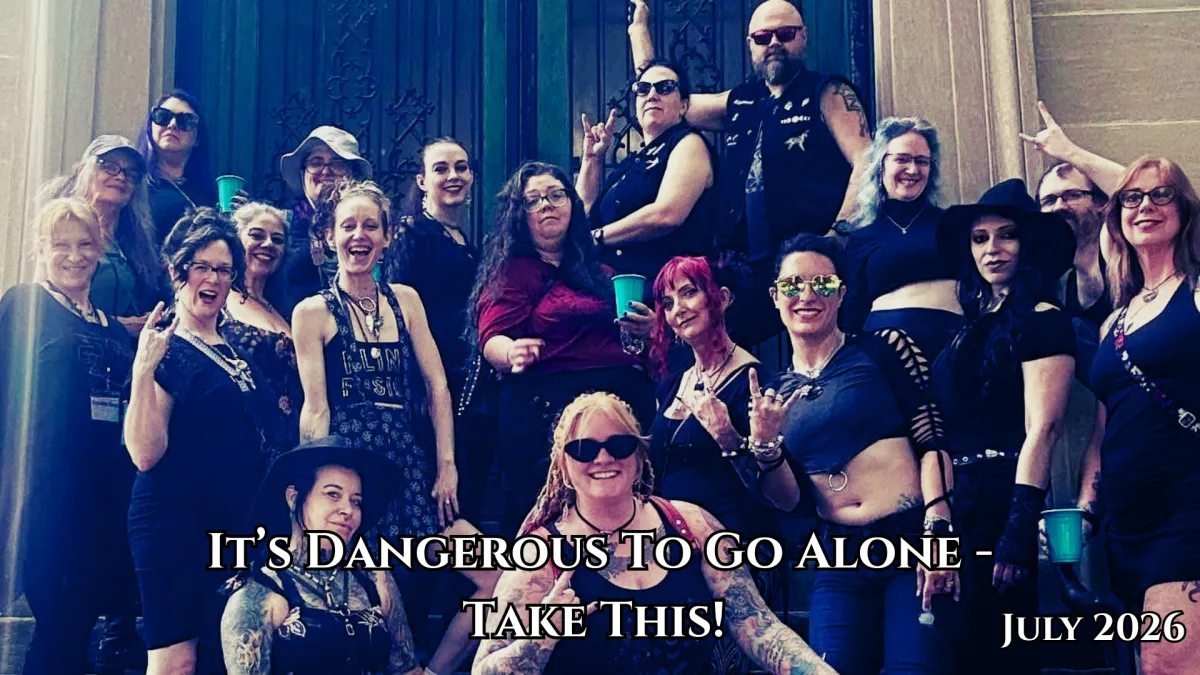
It's Dangerous To Go Alone - Take This!
My local belly dance community is amazing. Many of us have been dancing in our city for multiple decades, and most of us check in frequently on each other, recommend one another for gigs, and have genuine friendships outside of dance studios. As hobby communities go, you could do a whole lot worse.
That said, I am very frequently THAT dancer at local events. I usually walk into workshops in my usual fusion/metal black and silver and face a sea of sequins, bedlahs, and a rainbow of bright colors and pep. When I perform at local shows, I’m bringing crows and thunder and rage; my fellow performers are bringing gorgeous veil solos or “Shik, Shak, Shok.” A few years ago, I hosted a nerd-themed show and asked everyone to dance what they were most nerdy about. I showed up in a Lord of the Rings costume. My friends showed up in the aforementioned bedlahs, because they were nerdy about belly dance.
Inevitably, it’s always fine and we all embrace the differences with humor and mutual respect. But it does sometimes feel lonely, being THAT dancer, and six years ago (holy shit, six years already?!) I sought out to find a community where I could not only be weird without worrying I was bothering someone, but also see what originally drew me to fusion dance reflected in the other members around me.
This post isn’t exactly about finding a dance community; I think it’s a universally held belief that dancing and learning with others makes the experience more meaningful and special. This blog is about finding a community that matches your freak, especially if fusion isn’t popular in your local dance area.
Why Fusion Dance Can Be Uniquely Isolating
Traditional dance forms, whatever their difficulty, usually come with structure and common language between studios and teachers. There’s a codified vocabulary, a progression of levels, and a distinct student/teacher hierarchy that makes things easy to categorize and predict. Fusion dance draws from group improv, gothic, contemporary, and folkloric influences into something that resists easy categorization. For many dancers, that’s the appeal. It’s also the source of a particular kind of anxiety, especially if the style isn’t prevalent in a particular city or area.
When there’s no fixed standard, the question “am I doing this right?” doesn’t have a clean answer. I’ve caught myself second-guessing performances as I’m standing in the wings, constantly wondering “Is this too much? Will people even get it? Should I be performing fusion at all at this very raqs sharqi-coded event?” It’s in these situations where having an alternative community specifically for fusion/dark fusion dancers isn’t just a nice thing to have, it’s basically a social lifesaver. The truth is, fusion dance (especially dark fusion and other alternative styles) is still fighting for its place to belong in the belly dance or belly dance-adjacent world. Depending on the attitudes towards fusion in your area, you may be welcomed with enthusiasm or (unfortunately sometimes) gatekept from the community because you’re on the dark side of the dance world.
Alternative Dance Spaces Keep You Showing Up For Yourself, Even When You Feel Alone
Almost every dancer has a story about the class or rehearsal they almost skipped. Maybe it was after a rough week at work, or a fight with a partner, or simply a wave of self-doubt about whether they belonged in the room at all. For some folks, internal motivation and genuine love for the dance is enough to get them off the couch and into the studio. For most of us, it probably takes a little bit more to shake off the funk.
Within the Stygian Collective, we have an understanding: you don’t have to arrive polished. You don’t have to have your choreography memorized or your isolations on lock. You just have to show up, and the Collective will meet you where you are. The reassurance that you can show up messy, show up mad, show up confused helps take the intimidation out of just…showing up.
This is especially true for dancers working through trauma, possibly from hypercritical instructors, troupe drama, or just the stupid gremlins that infest your brain when chemicals aren’t balancing and life is hard. The power of radical support and genuine validation for new members, dancers adjusting to new bodies after injuries or life changes, or someone dealing with body image issues cannot be overstated. Showing up is 99% of the battle, and knowing a community of fellow misfits are there to have your back when you walk through that virtual “door” is a massive motivator to take the plunge.
Accountability Is a Catapult, Not a Cage (Yes, Even For You, Introverts)
The word “accountability” makes me twitchy. It reminds me of years spent in conservative Christian youth groups, where we had accountability partners for everything from bathroom breaks to date nights to just thinking normal teenage thoughts. But accountability, when used in a healthy and supportive way, can be a serious tool for personal growth.
I am a Category 5 Introvert. I’m perfectly happy never speaking to another human being for days on end, and social events leave me drained for days afterward. I have never once been tempted to seek accountability buddies for things like exercise, goal setting, or travel. That said, when I found the Stygian Collective, and slowly started getting involved in performances and workshops, I realized that the organically built-in accountability of having to organize things with several people made me focus and practice way more than I ever did on my own projects. Even for folks who would rather have a root canal than go to a social hang, the power of community has its benefits. (You might even find yourself enjoying it a little).
Community Isn’t Conformity
There sometimes can be a version of community and accountability that isn’t healthy. If community starts to mean “we accept the same kinds of dancers, dancing the same style of dance, who all look fairly similar and have the same values,” you haven’t built a community; you’ve created a high-control group instead.
Healthy accountability in a dance community sounds like “we missed you last week, everything okay?” Unhealthy accountability sounds like guilt-tripping someone for taking care of themselves. Healthy accountability holds space to be different, imperfect, and at different stages of their dance practice. Unhealthy accountability compares dancers against each other in ways that erode confidence rather than build it.
The Stygian Collective works HARD to be an exemplar for healthy dance communities. We agonize over creating enough structure that people feel pulled toward consistency, without creating so much pressure that dance becomes another source of anxiety rather than a release from it. We intentionally create performance opportunities and get-togethers that celebrate our individual differences while using our shared values and commitments as a thruline to unite us. We still have a lot to learn and we’re not always doing it right, but we show up and we try. And that makes all the difference.
Read Our Stygian Values and Standards Here
Friendship is an Engine of Longevity
Ask any longtime dancer why they’ve stuck with a studio for years, and technique and expectations rarely top the list. It’s almost always the people. The friend who always saves you a spot in the studio. Rehearsals that veer off into coffee runs or dinner or a two hour bitch sesh in the parking lot. The group chat that keeps buzzing between practices with memes, encouragement, and inside jokes.
These relationships transform dance from a hobby you do into a community you belong to, and that distinction is super important to maintaining longevity in dance practice. Hobbies are easy to drop when life gets busy or hard. Communities are much harder to walk away from, because walking away means losing not just an activity but a network of relationships that have become genuinely important. I have broken up with belly dance more times than I can remember, but after I’m done stomping my foot and being mad about it, I remember that dance is how I met most of my best friends, and I’d miss them if I wasn’t there to share their experience.
This is why the Stygian Collective functions more like a brilliantly chaotic, 24/7 family reunion than a traditional dance studio, complete with inside jokes, shared rituals, and the kind of low-key caretaking that shows up when someone’s going through a hard time. The social fabric Daewen and the Collective have developed over the past six years does the heavy lifting to keep dancers feeling safe, supported, and energized to keep being creepy far longer than if we were out there doing it all on our own.
Dancer Tested, Athlete Approved
My original plan was to title this blog “Everything I Learned About Belly Dance Community I Learned By Teaching Septuagenarians The Cupid Shuffle”, but the SEO validator flagged that that did not trip lightly off the page. I’ll get to that point soon, though.
My top 3 great loves in my life are: my family, music and dance, and my work as a group and personal trainer for senior citizens at a local gym. (Also my electric lawnmower is in the mix because it’s awesome).
The athletes I work with there are easily some of my favorite people on the planet, and as cliche as it sounds, I’ve learned way more about life than I’ve taught them about fitness. The one resonating and persistent lesson I’ve learned from my years of working with that population is that isolation ages you more than almost anything else out there, and finding a group of people to depend on daily will get you out of bed like nothing else.
The seniors at my gym are the most ferocious protectors of community and each other I’ve ever seen. If someone is missing for more than a few classes, we immediately contact them and make sure they’re okay. If someone is hurting or sad, there are always small groups who will offer prayers or pull them outside just to talk and be heard. They advocate for themselves, and they advocate for each other every single day. Their classes have become not only a way to stay active in their bodies, but also a source of positive mental health and an alternative family for the participants who might not have relatives or friends left nearby. In a few cases, holding on to a chosen community and letting them hold its members in turn has been the difference between life and a lonely death.
The stakes might be a little higher for my senior athletes, but the lessons do apply to fusion dance and the Stygian Collective: Show up, look out for one another, keep being weird.
Even if you have a local community of the best people on earth like I do, it’s still completely normal and okay to feel a little out of place. Finding an alternative community like the Stygian Collective definitely helps, and may hopefully even help you find yourself as a dancer.
Ready to open the door to your dance home away from home? We’ve left the welcome mat out.
Click Here to Learn More About the Stygian Collective (and snag your FREE 7-Day Trial Membership!)

